Development is divided into distinct stages, within approximate age ranges. The core premise is that you commit to the Structure at your current stage when your coping needs for survival exceed the level of support received from your caregiver and environment. You adopt the structure that’s most advantageous to your survival, when that need is not met by your environment, in order to defend against the Symptom of that structure. If a sufficient amount of support is received, then you progress to the next stage without committing to its corresponding structure.
In other words, you land on the structure which is optimally, intelligently adaptive to your environment.
What Drives Progression
Three distinct aversive phenomena appear in this framework and are easily collapsed into “suffering.” They have opposite developmental valences, and keeping them apart is what makes the model coherent.
1. Support failure — causes commitment, not progression
The core premise above: you commit to a structure when coping needs exceed available support. This is the pain that traps. It fixes you at a position rather than moving you through one, and it keeps operating after the initial commitment.
- The less external support someone receives, the less likely they are to progress.
- When stability is important — e.g. a single parent working two jobs to raise their kids — progress is less likely.
- Deprivation produces fixation. This is the opposite of the folk intuition that hardship builds character.
- Corollary: anything that raises baseline support is pro-developmental. Material security, stable relationships, and adequate care are not distractions from growth; they are its precondition.
- spencer-question Would you ever choose not to progress? e.g. harder to relate to people at an earlier structure
2. The Symptom — the medium, neither fuel nor obstacle
Derealization, Depression, Anxiety, Jouissance, Boredom, Ideology. These are not suffering in the ordinary sense and their presence is not a sign that progression is underway.
- The individual notes are consistent on this: these are “breakthrough, not breakdown,” “philosophical achievement.” Depression’s meaninglessness is oddly liberating; Anxiety’s source is clarity rather than distortion.
- The mature relation to a symptom is mastery, not escape — see the lion-hunter analogy in Information Processing Mechanisms. The Crisis-phase person uses the mechanism most skilfully and fears the symptom least.
- People also enjoy their own structure’s symptom when it is sanctioned: Psychotics and tragic films, Neurotics and rollercoasters, Detached people and cosmic horror.
- Therefore: intensity of symptom does not indicate proximity to transition. A person deep in Anxiety may be nowhere near Perversion.
3. Strategic exhaustion — the actual engine
Going through a personal crisis corresponds with progress. But the operative element is not the pain of the crisis. It is the discovery that your best available move no longer produces the outcomes you want — at which point you must debug, gain insight, and let go.
Note that the Crisis phase is not described as the most painful phase. It is the most confident, self-assured, capable phase — “troubled” only in the sense of being lost in thought, working something out.
Strategic exhaustion has two ingredients, and removing either one stops progression:
- (a) Outcomes you want. There must be something at stake that you are actually trying to get.
- (b) A strategy that fails to get them. The structure’s repertoire must be genuinely exhausted, not merely inconvenient.
Most life circumstances attack (b): the environment changes and the old trick stops working. This is the ordinary route, and it announces itself — the person knows something is wrong.
Conditions that attack (a) are more thorough and far harder to detect, because the absence of a failure signal is experienced as success. Someone who has stopped wanting outcomes has no crisis to work through and no reason to look for one. See Contemplative Attainment for the clearest case. claude-synthesis
Worked example — Neurotic → Perverse: in the Crisis of Neurosis you have exhausted every combination of rules available for “being good.” The only remaining move is to be bad. The currency spent here is not pain but self-image: you must submit to being bad, e.g. to a vice, and be willing in the moment to choose it. Note what this requires — being bad has to still cost something. If the stakes have been dissolved, the violation isn’t a violation, and the bridge doesn’t form.
The ideal developmental condition
Putting the three together yields a non-obvious corollary: progression is most likely under high support combined with high stakes — not under adversity.
- High support, low stakes → comfort, no exhaustion, no movement.
- Low support, high stakes → commitment and fixation; survival crowds out debugging.
- Low support, low stakes → arrest.
- High support, high stakes → the person can afford to have their strategy fail, and cares enough that its failure registers.
This is also why “mini-steps within a phase” accumulate into a springboard: each small failure is survivable because support is adequate, and meaningful because something was wanted.
claude-synthesis — the three-way distinction and the high-support/high-stakes corollary were derived in conversation, not from prior vault content. See Epistemic Status.
See Also
- Crisis — the phase in which strategic exhaustion completes
- Symptom — what the mechanisms defend against
- Information Processing Mechanisms — mastery as the marker of progress within a structure
- Contemplative Attainment — the case where ingredient (a) is removed
- Epistemic Status — standing of the claims on this page
Additional Notes
- “Support” can mean many things, like emotional support, financial support, even the global situation.
- After committing to a structure, you continue to progress through the developmental stages, but your adopted structure will affect how you think and act throughout later stages. You may still gain skills associated with later structures, but they will be of a different quality.
- It is possible, though difficult to progress to a later structure once one is committed.
- Information Processing Mechanisms take up a large proportion of our background processing power without us realizing. Once we learn new structures, we achieve mastery of more mechanisms, unlocking more processing power for conscious processing of information, as if upgrading computer architecture. Information processing speed generally increases as you progress through structure.
- Each structure and phase within a structure is forward-motion only. In other words, regression (reversal of progress to an earlier phase or structure) is generally not possible, unless an event like brain damage occurs.
- There are mini-steps within a phase, like mini-epiphanies. Small changes in perspective or new fixations develop, which are temporary by design. But with a sufficient amount accumulated, can act like a springboard to allow the person to progress to the next phase.
- Why wouldn’t someone progress?
- The less external support someone receives, the less likely they are to progress.
- When stability is important, e.g. a single parent working 2 jobs to raise their kids, then progress is less likely.
- spencer-question Would you ever choose not to progress? e.g. harder to relate to people at an earlier structure
- What causes someone to progress?
- Going through a personal crisis seems to correspond with progress.
- In other words, when your current structure, your current strategy for interfacing with reality, starts failing to produce the outcomes you want, you must debug, gain insight, and let go.
- To progress in a structure is to gain control of the primary Mechanism of that structure.
- Earlier structures will use words like Anxious or Depressed to describe a real sensation they have, but it’s not really the same.
- Detached people will say they feel anxious, but really they feel some other aversive emotional experience. It makes sense to call it anxiety, but it’s not the same as the anxiety that a Neurotic will experience. It’s closer to Derealization.
- A Pervert may feel a new feeling which they don’t yet have a word for, because it corresponds with a later structure.
- You can think of
- From Dissociative to Schizophrenic
- From Neurotic to Perverse
- In the Crisis of Neurosis, you’ve exhausted all possible combinations of rules that are available to “be good”. The only choice is to be “bad”. You are faced with a contradiction: either be “bad”, or end things altogether to avoid the possibility of no longer being good and preserve your image. The neurotic who progresses will submit to being bad, e.g. submitting to a vice (drugs, alcohol, etc) to cope with reality. To be willing in the moment to choose to do something bad is the bridge to perversion.
- Sometimes psychotics, neurotics, etc. seem dumb or weird because, well, some people are dumb and weird. But a smart, thoughtful Detached person will progress into a smart, thoughtful Psychotic, and so on.
- Cycle of expansion and contraction
- Expansion in Liminality, contraction in Crisis. Only applies in Detachment through Perversion.
- After Perversion, it’s not the same. Jesus calls it the “upside-down kingdom”.
- People in the Middle Ages speak of being “born again”. See Society.
- Inner voice spencer-hypothesis
- A person’s relationship with their inner voice / inner monologue changes over time.
- The Detached person doesn’t identify with their inner voice. They don’t see themselves as the source of it, but as the listener. They are subject to this voice, but are not the voice themselves.
- This becomes inverted in Psychosis: they begin to identify as the voice.
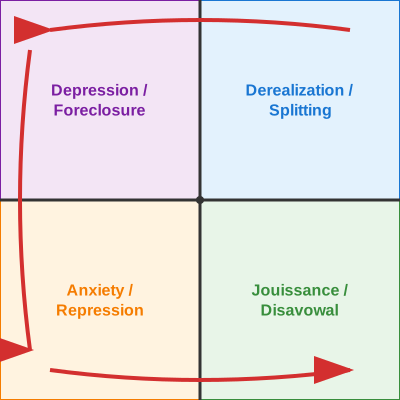
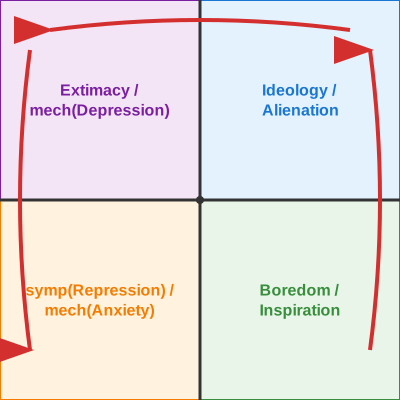
- The structures form a cycle
- Detached -> Psychotic -> Neurotic -> Perverse
- Seminal -> Sacral -> (Structure 7) -> (Structure 8)
- Detached people identify with the Ego-ideal and their project is the organ (imaginary phallus).
- Psychotics identify with the organ (imaginary phallus) and their project is the persona.
- Neurotics identify with the persona and their project is the Name-of-the-Father.
- Perverts identify with the Name-of-the-Father and their project is the ego ideal.
- When a Pervert “finishes” their project, they don’t become Detached again, but the cycle “flips”. It’s like the back of Quadrant 4 is Seminal (Quadrant 5).
- Structures on opposite sides have their symptoms and mechanisms reversed.
- Detached (Q1) is opposite from Sacral (Q6)
- Detached symptom is Derealization (feeling apart from the world), and the mechanism is Splitting (creating delineation, separating, and creating a new world state)
- Sacral symptom is Ideology (feeling as though you’re on rails, like the world state is pre-determined), and the mechanism is Alienation (isolating oneself from the world)
- Perversion (Q4) is opposite from Seminal (Q5)
- Perversion symptom is Jouissance (pain, enjoyment), and the mechanism is Disavowal (knowing about but denying a lack)
- Seminal symptom is Boredom (knowing everything, lacking interest), and the mechanism is something like self-awareness/self-denial.
- Psychosis (Q2) is opposite from Structure 7 (Q7)
- Psychosis symptom is Depression, and the mechanism is Foreclosure
- Structure 7 symptom is Extimacy, and the mechanism is something like anhedonia (?)
- Detached (Q1) is opposite from Sacral (Q6)
- Detached -> Psychotic -> Neurotic -> Perverse
- Being in different structures feels different, a different state of mind akin to being on different drugs, or under the influence of certain hormones.
- tiffani-hypothesis Progressing frees up processing power; there are parts of the brain that can be culled or repurposed when we progress because they’re not needed as much anymore.